Pattern Grading: A Beginner's Guide

It is 2 a.m. in Istanbul and a factory tech is on WhatsApp asking why the size 3X bodice on a graded pattern measures 4 cm wider at the shoulder than the size grade chart says it should. The sample size fit beautifully. The size 1X was acceptable. But by the time the grade walked out to 3X, the shoulder slope had drifted, the armhole had opened, and the factory is now asking whether to cut or wait. That single grading error, caught at the cut floor instead of in the pattern room, is what separates a clean production run from a week of rework charges.
Pattern grading is one of the essential skills you need to master to excel in pattern making. At its core, pattern grading involves resizing a base pattern, also known as a master pattern, into a full size range. The base size, sometimes called the sample size, is the original starting point from which other sizes are developed. This original pattern serves as the initial template used for grading, ensuring consistency and fit across the size range. You create a master pattern and grade it up (increase) or down (decrease) without altering the original design.
Pattern grading saves you the trouble of recreating a pattern over and over to produce a style in different proportions, which would be a laborious process. New sizes are created from the base size through the grading process. In this post, we will dive into what pattern grading is, why it matters in production, the grading rules that govern a size run, and the three methods you can actually use.
What is pattern grading?
Pattern grading is the technical process of scaling a single base pattern into a graded set of sizes by applying defined measurement increments to specific points on the pattern, so that the fit, balance, and proportion of the original sample size are preserved across the entire size range. It is not uniform scaling. A 1 cm increase across the bust does not mean a 1 cm increase everywhere, because the human body does not grow uniformly between sizes.
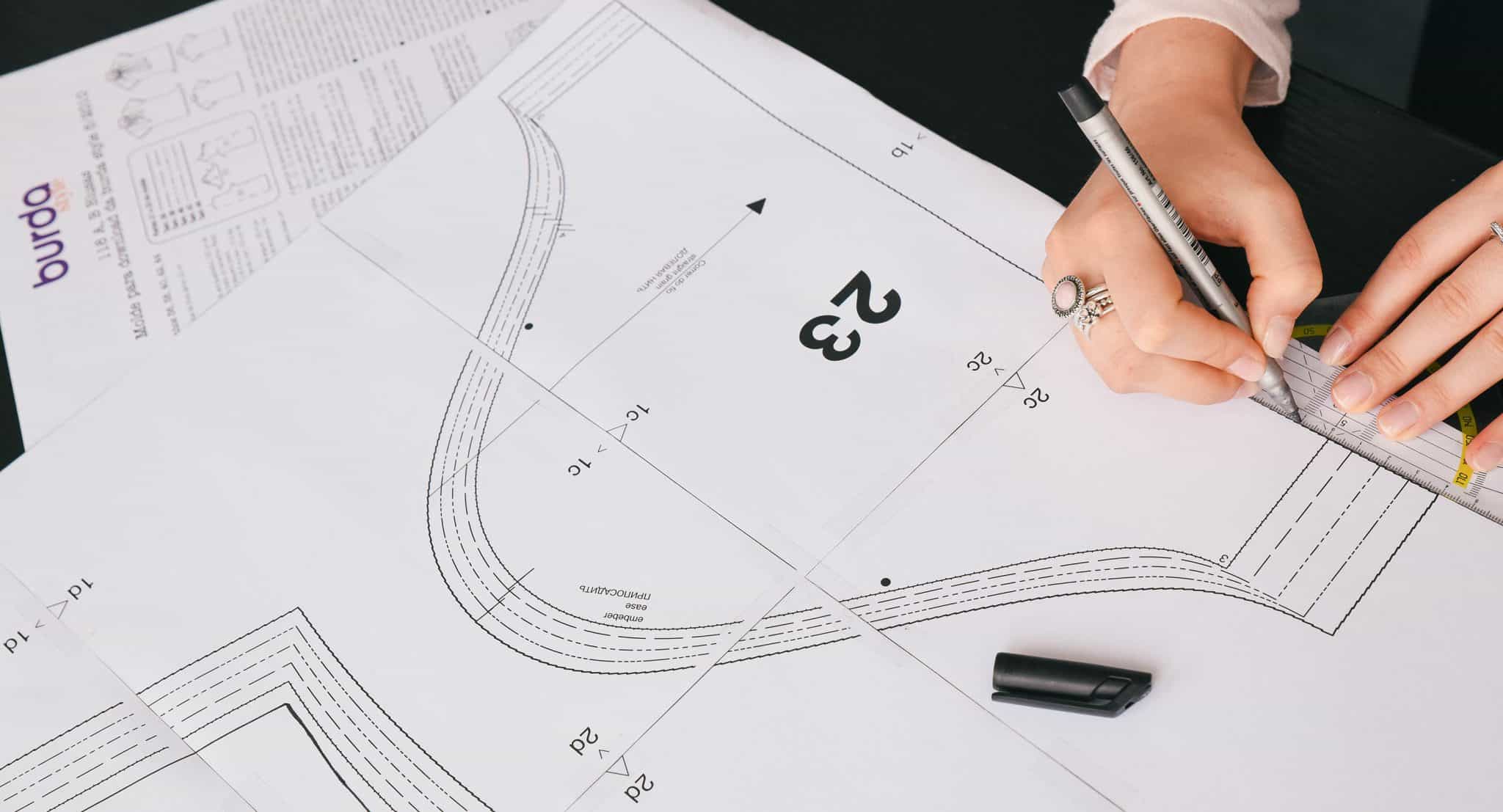
Pattern grading can be done manually with tools like rulers and grading machines, with a grading ruler being an essential tool for accuracy, or digitally using CAD software. For basic manual grading, the only tools required are a pencil, ruler, scissors, and measuring tape. Pattern grading can also be used in mass production by applying it to commercial patterns.
Key concepts include grade rules, which dictate how much the pattern increases or decreases between sizes, and grading increments, which are the systematic measurement adjustments made between sizes. Measurement is crucial for determining how much each pattern piece should be adjusted. Horizontal lines and vertical lines are marked on the pattern as reference points for grading. Slash lines guide where the pattern is cut and spread during grading. When grading a bodice pattern, both the front and back pieces are adjusted proportionally to maintain fit and style.
Why does pattern grading matter in apparel production?
From the production runs I have audited this year, the pattern is consistent: grading errors do not show up in the pattern room. They show up at the cut floor, at the fitting, or two months later in the returns data on size 2X and XXS. By that point, the cost is no longer the cost of fixing a pattern. It is the cost of the cut, the trim, the labor, and the customer trust.
Here is why grading deserves the same operational rigor as a tech pack.
Consistency in fit across sizes. Pattern grading ensures that every size variant of a garment provides a consistent fit, which is essential for brand credibility and customer loyalty. Consumers expect the same style and comfort in a size XS as they do in a size XL, and effective grading makes this possible. A brand that nails fit at size M but loses the armhole shape at size 2X will see the returns concentrated at the tail of the size run, which is exactly where margin gets eaten.
Cost efficiency. By allowing designers to create multiple sizes from a single basic pattern, grading reduces the time and cost associated with developing individual patterns for each size. This efficiency is crucial in keeping production costs down and staying competitive in the apparel market.
Enhanced design scalability. Grading allows fashion designers and companies to reach a broader audience by making their designs accessible to people of different sizes and body types. This inclusivity expands market reach and increases sales potential, particularly for brands extending into size 14+ or petite ranges where grading rules differ meaningfully from straight-size grades.
Quality control. Proper pattern grading helps maintain the quality and integrity of the design through all sizes. It ensures that the enlargements or reductions in the pattern do not distort the original design aesthetics or functionality. The neckline that looks intentional at size S should not gape at size XL.
Innovation and flexibility. With advancements in digital pattern grading, designers have more flexibility to experiment with complex designs and intricate details. Modern software not only speeds up the process but also increases precision, allowing for innovation and faster response to market trends.
What are pattern grading rules?
Pattern grading rules are the specific measurements and increments used to enlarge or reduce a pattern to create different sizes from the original. Grading rules can be based on specific customer measurements or general body measurements, allowing for a more tailored and inclusive fit.
These rules determine how much the pattern will change between sizes and are crucial for achieving proper fit and comfort. For consistent sizing, most patterns require grading rules to be applied to the whole pattern, ensuring that all parts of the garment are adjusted proportionally.
A typical grade chart for a women’s bodice might specify a 1 inch bust increment between sizes, a 0.25 inch shoulder increment, and a 0.5 inch waist increment. Those three numbers are not interchangeable. Apply the bust grade to the shoulder and you will end up with a garment that fits the chest but slides off the shoulders by size XL. This is why grade rule libraries get versioned and treated as proprietary IP inside serious apparel brands. Lose the library, and you lose fit consistency across every future style built on that block.
What are the three methods for pattern grading?
There are different methods for resizing sewing patterns without a loss in form. The three basic methods used to grade a pattern are as follows.
How does the cut and spread method work?
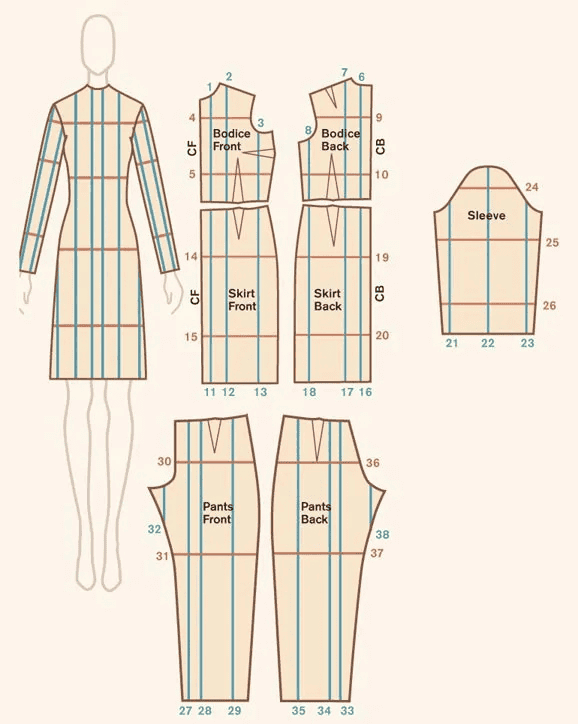
This is the easiest method for grading a pattern. As the name suggests, it involves creating a pattern and cutting it along the fold lines. Slash lines are marked on the pattern to indicate exactly where to cut for spreading or overlapping the pieces.
The cut pieces are then spread or receded by a certain amount to create a consistent pattern. To grade up, the gap between the pieces is increased uniformly. To grade down, the distance is receded, causing the pieces to overlap. The advantage of cut and spread is that it is visual and intuitive. The disadvantage is that it is slow and prone to drift over a full size run.
How does pattern shifting work?
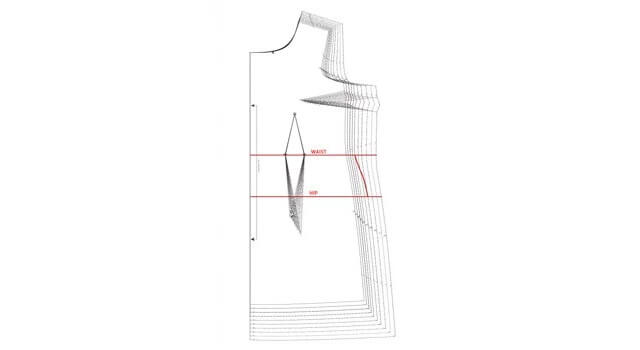
In pattern shifting, the pattern pieces are moved around at a constant distance and traced out on paper. This approach is also known as the shift method. To make a pattern smaller, you move it inwards by a small distance from a fixed point, up by the same amount, and then trace. The process is reversed to make the pattern bigger. The shift method is designed to achieve the same results as other grading techniques, such as cut and spread, but with less destruction of the original block.
What is computer grading?
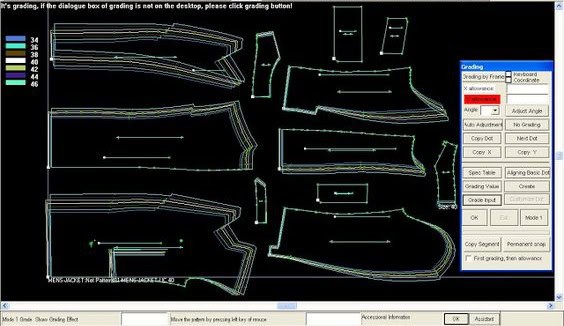
Computer grading involves making use of CAD software programs, such as Gerber AccuMark, Optitex, Lectra Modaris, or Adobe Illustrator, to grade patterns. It is faster and more efficient, and most importantly, it is repeatable. A grade rule applied in CAD can be saved, versioned, and reused across every future style that shares the same block. For any brand running more than 30 SKUs per season, computer grading is no longer optional.
When should you grade manually versus with digital tools?
When it comes to grading sewing patterns, pattern makers can choose between grading manually or using digital tools. Grading manually involves hands-on techniques like the spread method or pattern shifting, where each pattern piece is adjusted by hand to create different sizes.
Manual grading still has a place. For a one-off custom commission, a single sample, or a designer working a couture block, manual grading is fine. The grade lives on paper, the block lives in a drawer, and that is acceptable when the volume is low and the size range is narrow.
Digital grading wins the moment a brand crosses into wholesale, multi-size production, or anything that requires a tech pack handed off to an overseas factory. The argument is not about speed. It is about consistency and traceability. A grade rule stored in CAD can be audited. A grade rule stored in a pattern maker’s head cannot. When that pattern maker leaves, the institutional knowledge goes with them, and the brand spends the next six months rebuilding grade libraries from existing samples.
My position is unambiguous: if you are producing more than two collections per year at wholesale volume, the cost of staying manual is higher than the cost of moving to CAD. The break-even is not in the software license. It is in the rework charges you stop paying.
How does pattern grading connect to the rest of apparel operations?
Grading does not live in isolation. A graded pattern is part of a tech pack, the tech pack is part of a style record, and the style record is what flows into production planning, cut tickets, and ultimately the SKU table that drives inventory, order, and warehouse execution.
This is where grading touches the 6 Breakpoints of Apparel Operations. Breakpoint 1 is product data fragmentation. A grade chart that lives in one pattern maker’s CAD file, while a different version lives in the tech pack PDF, while a third version lives in the factory’s spec sheet, is breakpoint 1 in action. By the time those three versions disagree, the brand is already paying for the disagreement in returns and rework.
The fix is structural. Grade rules belong in the product data layer, attached to the block, versioned with the style, and referenced by the tech pack rather than copied into it. Uphance treats grade specifications as part of the style record, so the size chart the warehouse sees and the size chart the factory cut from come from the same source. That is not a feature. It is a discipline.
What are the most common pattern grading mistakes?
The mistakes I see most often in production audits are not exotic. They are boring, repeatable, and preventable.
Applying the same increment everywhere. Grading a sleeve cap with the same increment as the bust will distort the armhole. Grade rules are point-specific for a reason.
Grading too far from the sample size. A grade rule that works from M to XL will start to fall apart by 3X if the brand has not validated fit at the extremes. The body changes shape, not just size, at the tail of the size run. Plus-size grading is a discipline of its own, not an extension of straight-size grading.
Not versioning grade rules. When the grade chart for a knit top gets reused on a woven top, the seam allowances and ease assumptions break. Every block should carry its own grade rule library, versioned and dated.
Skipping fit validation across the size range. Brands routinely fit-test the sample size and assume the grade holds. It does not always hold. Fit-test at size S, size L, and size 2X at minimum.
What are best practices for pattern grading?
To achieve the best results in pattern grading, pattern makers should follow a set of best practices. Start with a high-quality base pattern that is accurate and well-constructed, as this will serve as the foundation for all graded sizes. Establish clear and consistent grading rules to maintain proper proportions and avoid fit inconsistencies. Using digital tools can greatly enhance accuracy and efficiency, especially when creating multiple sizes.
It is also important to validate fit and quality throughout the grading process, using techniques like 3D prototyping and fit testing to catch any issues early. Tools such as Browzwear’s Design in Sizes can help with the creation of multiple size variations within a single digital file. By combining technical skills, attention to detail, and the right digital tools, pattern makers can create graded patterns that fit well, are consistent in quality, and meet the needs of a diverse customer base.
What this means for an apparel operations team
For a $5M to $100M apparel brand, pattern grading is not a pattern room problem. It is a product data problem with operational consequences. Every grading error that escapes the pattern room shows up later as a fit complaint, a return, a markdown, or a rework charge at the factory. The cost compounds.
Three operational moves are worth making. First, treat grade rules as versioned product data, not as PDFs attached to a tech pack email. Second, require fit validation at the extremes of the size range, not just at the sample size. Third, consolidate the grade chart, the tech pack size spec, and the warehouse SKU dimensions into a single source so the factory, the QA team, and the 3PL are all working from the same numbers. That is the kind of clarity that turns grading from a recurring source of returns into a controlled, repeatable process the rest of the operation can rely on.
Frequently asked questions
Where this fits in the Uphance platform
Ruchit writes about product strategy for apparel operations, covering how mid-market fashion brands use connected workflows to manage product development, inventory, orders, warehouse execution, and reporting. As Head of Product at Uphance, he shapes the roadmap that ties PLM, PIM, BOM management, allocation, fulfillment, and warehouse operations into one system. His articles dig into apparel-specific operational mechanics: tech packs, spec sheets, putaway, pick-pack, landed cost, and the data plumbing that makes inventory truth possible across multiple channels and locations. He focuses on the workflow-level questions that separate generic ERPs from systems built for how apparel brands actually run.
Ronnell writes about onboarding, adoption, and operational readiness for apparel brands moving to a connected platform. His articles focus on what it takes to go live with confidence and sustain strong execution across channels, warehouses, and teams. As Head of Customer Success and Onboarding at Uphance, he leads the implementation phases that turn a software signature into running operations. He writes about kickoff scoping, data migration, sandbox cutover, change management patterns, and the stakeholder alignment work that determines whether a connected platform actually changes how a brand runs, or just adds another login to the existing chaos.