Best POS Systems for Apparel Brands (2026)
It is Saturday afternoon at a flagship store in SoHo. A returning DTC customer walks in holding a phone with three items in her Shopify cart. The associate cannot see her order history because the retail POS and the DTC platform hold separate customer records. Two hours earlier, the same store sold the last unit of a popular SKU, but the website kept offering it until the 11 AM sync and a DTC order shipped against stock that no longer existed. By Monday morning, the operations lead is reconciling a retail-DTC oversell, a missed loyalty credit, and a margin report that does not match the bank deposit.
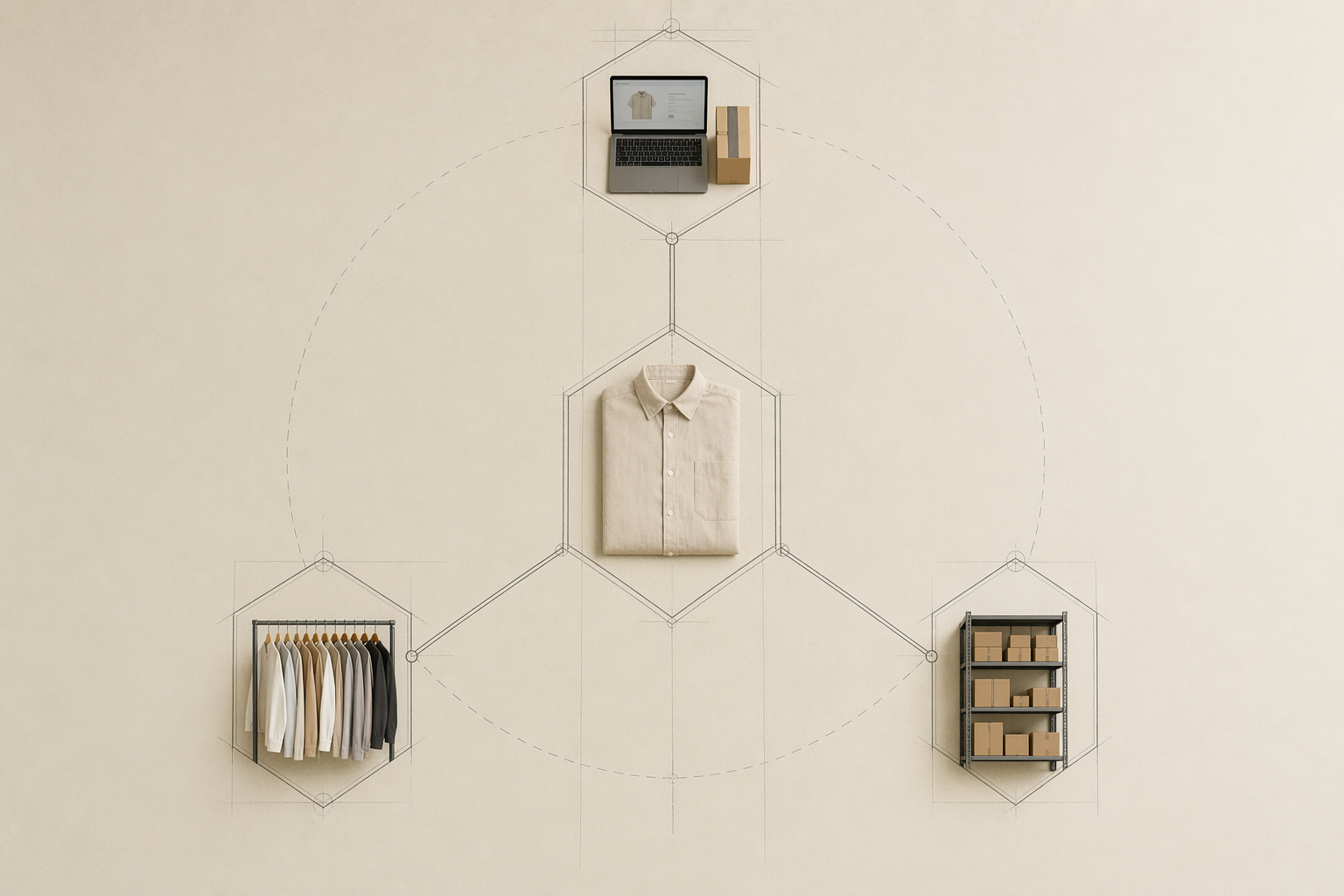
That scene is the reason point-of-sale software for apparel becomes a fit question, not a feature question, the moment retail runs alongside wholesale and DTC. Most retail-focused POS systems were designed for retailers, not for apparel brands that happen to operate retail. The distinction matters because the inventory pool, the customer record, and the order workflow all need to span more than retail for the brand to operate cleanly. Choosing the wrong system creates a retail island. Choosing the right one connects retail to the rest of the operation.
This guide is a criteria-led comparison of the POS systems apparel brands $5M to $100M actually evaluate when retail is part of a broader multi-channel operation. It covers what causes brands to outgrow basic POS, the four operating-model questions that determine fit, a side-by-side comparison, and a decision matrix by retail profile.
What is an apparel POS, and why is it different from a retail POS?
An apparel POS is the point-of-sale layer of an apparel operation: the terminal that records retail transactions, the database that holds retail inventory and customer records, and the integration path that connects retail to DTC, wholesale, warehouse, and accounting. A retail POS solves checkout. An apparel POS solves checkout plus channel coordination. The difference shows up the first time retail draws from the same physical stock as DTC fulfillment or the first time a wholesale shipment reduces the units available at the store counter.
From the go-lives I have run this year, the pattern is consistent: brands that treated POS as a checkout decision spend the next twelve months reconciling retail against DTC and wholesale by hand. Brands that treated POS as a channel decision spend that time merchandising and reordering. The cost of the wrong fit is not the license fee. It is the operations hours absorbed every week to make retail numbers match the rest of the business.
When does an apparel brand outgrow basic POS software?
Most apparel brands start retail with simple software. Square or Shopify POS at the counter, a single store or a small footprint, manual inventory updates between retail and the rest of the operation. The arrangement works because retail volume is contained and reconciliation across channels is manageable.
Three breakpoints typically end that arrangement.
The first is the inventory-pool breakpoint. Retail starts drawing from the same physical stock as DTC fulfillment, but the systems holding retail orders and DTC orders do not share an inventory database. A retail customer buys the last unit of a SKU at 10 AM. The brand’s website continues offering that SKU until the next sync at 11 AM. The brand sells it again to a DTC customer in that hour. The retail-DTC oversell pattern starts. This is Breakpoint 3 in the 6 Breakpoints of Apparel Operations framework: inventory truth gets weaker.
The second is the customer-recognition breakpoint. A loyal DTC customer walks into the retail store. The retail POS does not recognize the customer because the customer record lives in a different system. The store associate cannot see the customer’s order history, cannot apply DTC loyalty credit at retail, and cannot record the retail purchase against the customer’s profile for future personalization. The customer experience fragments at the moment the relationship matters most.
The third is the multi-channel reporting breakpoint. The brand needs to see total revenue, total margin, and total inventory by SKU across retail, DTC, and wholesale to make merchandising and reorder decisions. The retail POS reports retail. The DTC platform reports DTC. The wholesale platform reports wholesale. Combining the three into a coherent operational picture requires manual roll-up that finance and merchandising redo every month. That is Breakpoint 6 surfacing: reporting becomes reactive.
The signal that a brand has hit one or more of these breakpoints is consistent: retail still works in isolation, but the team cannot see retail as part of one operational picture. That is the moment basic POS stops being enough.
What four questions actually determine apparel POS fit?
The vendor evaluation conversation usually starts with feature lists. The right filter is operating model. Four questions narrow the choice for most apparel brands.
Does retail draw from the same inventory pool as DTC and wholesale?
This is the highest-leverage question. A brand running retail alongside DTC and wholesale needs all three channels reading from one shared inventory record. Retail sales reduce DTC and wholesale availability immediately. Wholesale shipments reduce retail availability immediately. There is no nightly sync between separate stock pools.
Most retail POS implements this through periodic synchronization with a separate inventory system. The model works for retail-only brands but breaks for brands where retail is one of multiple channels drawing from one stock pool.
What to look for: a single SKU record visible from retail, DTC, wholesale, and warehouse views, with one underlying stock count. If the system you are evaluating maintains a retail inventory separate from a DTC inventory with sync between them, it is not solving the multi-channel apparel problem.
Is the customer record shared across retail and DTC?
A returning DTC customer who walks into the store should be recognized at the counter. The customer’s order history, loyalty status, size profile, and preferences should be visible to the store associate. The retail purchase should be recorded against the same customer record so future DTC marketing reflects the full relationship.
Retail POS systems vary widely on this. Some maintain entirely separate customer records from the DTC platform. Some integrate customer data through periodic sync. Few share one customer record at the database level.
What to look for: a single customer profile visible from retail and DTC at the database level, with no duplication and no synchronization gap.
How many stores, and how complex is multi-store?
Single-store retail and multi-store retail are different problems. Multi-store specifically introduces inter-store inventory transfers, store-specific pricing or promotions, store-specific tax configurations, and store-level reporting. A POS designed for one store often handles two or three stores acceptably and breaks at five or more.
What to look for: native multi-store inventory management, the ability to view and transfer stock between stores, store-specific tax and currency configuration, and consolidated reporting across stores.
How tightly does the POS need to integrate with the operating record?
The POS is one of several systems in the apparel operation. Inventory, accounting, ecommerce, wholesale, warehouse, and reporting all touch the same data the POS produces. The integration depth determines whether retail produces operational truth or operational noise.
Native integration means retail orders flow into the same operating record that holds DTC, wholesale, and warehouse data, with no manual reconciliation. Lighter integration means periodic sync between systems, with the operations team managing the differences. No integration means retail is an island that the operations team treats as a separate business.
What to look for: native integration with the brand’s accounting system, native integration with the ecommerce platform if DTC is significant, and a clear data path from retail orders into operational reporting.
Which POS systems should apparel brands actually shortlist in 2026?
The five systems below are the ones most often shortlisted by apparel brands $5M to $100M when retail is part of the operating mix.
| System | Best for | Inventory pool | Customer recognition | Multi-store | Integration depth |
|---|---|---|---|---|---|
| Uphance | Apparel brands $5M to $100M with retail as one of several channels | One pool across retail/DTC/wholesale | Shared at database level | Native | Native (operating platform) |
| Shopify POS | Shopify-DTC brands with attached retail | Shared with Shopify DTC | Shared with Shopify | Through configuration | Tight (Shopify ecosystem) |
| Lightspeed Retail | Multi-store specialty retail with limited DTC | Shared across stores | Native | Native | Through connectors |
| Square | Single-store apparel, low retail complexity | Limited, retail-only | Limited | Light | Through connectors |
| Clover | Single-store apparel with payment-led setup | Retail-only | Limited | Limited | Through connectors |
Vendor profiles below describe operational fit in more detail.
Uphance
Best for: apparel brands $5M to $100M where retail is one channel among DTC, wholesale, marketplaces, and B2B portal, with one shared inventory pool and one shared customer record aB2B portalchannels.
Uphance treats retail as a channel within the apparel operating platform rather than as a separate POS system. The same inventory pool serves retail, DTC, wholesale, marketplaces, and B2B portal. The same customer record is visible from retail and DTC. Retail orders, returns, and exchanges flow into the operating record alongside every other channel, which means accounting, reporting, and inventory truth all reflect retail without manual reconciliation.
Where this is the right answer: brands where retail is part of a broader apparel operation, brands operating two to ten retail locations alongside DTC and wholesale, and brands that want one operating record rather than a stack of point tools.
Where this is not the right answer: pure retail businesses with no DTC or wholesale, single-store apparel boutiques without operational complexity, and brands whose primary problem is checkout speed rather than multi-channel coordination.
Shopify POS
Best for: Shopify-DTC apparel brands with attached retail (one to five stores) where retail extends the DTC business.
Shopify POS shares inventory and customer data with Shopify DTC at the database level, which is its defining strength. A brand running $10M of Shopify DTC with two or three flagship stores gets retail integration for free, with no separate sync layer. The hardware is reasonable, the implementation is fast, and the staff training curve is short.
Where Shopify POS falls short: wholesale activity is not a first-class concern, multi-store complexity is acceptable but lighter than Lightspeed Retail, and brands with significant non-Shopify channels (wholesale platforms, marketplaces with their own order management) end up reconciling outside Shopify anyway.
Lightspeed Retail
Best for: multi-store specialty retail $5M to $50M, particularly apparel brands with five or more retail locations and limited DTC or wholesale.
Lightspeed Retail is the strongest standalone retail-focused POS on this list for multi-store apparel. The product handles inter-store inventory transfers, store-specific configurations, multi-currency for international stores, and apparel-specific data structures (size and color variants) reasonably well. Reporting across stores is genuine, not a workaround. Where Lightspeed falls short is the same place every retail-first POS does: wholesale and DTC connect through connectors rather than at the database level, which reintroduces the sync gap as soon as a second channel grows past hobby scale.
Square
Best for: single-store apparel boutiques with retail revenue under $2M and minimal DTC or wholesale.
Square is the easiest POS to set up and the easiest to operate at the counter. For a single-store apparel boutique with a small DTC tail, it is a defensible choice. The limits show up the moment retail expands beyond one store, the moment DTC volume warrants a real ecommerce platform, or the moment wholesale enters the operating mix. At that point Square is doing retail well in isolation and producing reconciliation work for everything around it.
Clover
Best for: single-store apparel where the payment-processor relationship drove the POS choice.
Clover is typically sold by a payment processor or bank. The bundled deal makes the math attractive for a single-store operator. As an apparel POS, Clover is functional but thin on apparel-specific data structures and weak on integration with the systems an apparel brand uses around retail. It is rarely the answer for brands above $5M unless retail is a marginal channel and the payment relationship is locked in.
How should an apparel brand pick by retail profile?
The decision matrix below maps retail profile to POS choice. The profile, not the feature list, drives the answer.
- One store, retail under $2M, DTC and wholesale minimal: Square or Clover. The fit is single-store retail, and the integration cost of anything more complex is not justified.
- One to five stores, Shopify-DTC, wholesale minor: Shopify POS. The shared inventory and customer record with Shopify DTC make this the obvious choice.
- Five or more stores, retail is the dominant channel, DTC and wholesale are secondary: Lightspeed Retail. Multi-store handling is the differentiator.
- Two to ten stores, retail is one of several real channels (DTC, wholesale, marketplaces, B2B portal): an apparel operating platform with retail capability. Retail needs to live in the same operating record as everything else.
- Pure wholesale with one or two showroom locations: an apparel operating platform with retail capability, configured for showroom-light retail. The operating record matters more than the POS feature set.
What does an apparel POS implementation actually require?
Software does not solve operational problems. Implementation does. Three things matter for any apparel POS rollout.
The first is hardware and payment-processor setup. Apparel retail typically needs a touchscreen terminal, a barcode scanner, a receipt printer, and a payment terminal that integrates with the POS. The hardware is straightforward but the configuration takes a half-day per store. The payment-processor relationship determines settlement timing and fee structure, which affects cash flow.
The second is inventory load. Existing SKUs, variants, prices, costs, and current stock counts have to move into the new system before go-live. For an apparel brand with thousands of size-color-style variants, this is the implementation step that gets underestimated most. Clean inventory load is the foundation of everything that comes after.
The third is staff training. Retail staff need to operate the new POS confidently from day one. The training curve is short for basic POS (Square, Shopify POS) and longer for operating platforms with retail capability because the staff are interacting with a system that does more than retail. The training investment pays back through fewer checkout errors and faster customer flow.
Standalone retail POS implementations typically run 2 to 6 weeks. Apparel operating platforms with retail capability run 8 to 16 weeks because the rollout includes wholesale, DTC, and warehouse alongside retail. The longer timeline produces a unified operating record rather than a retail island.
What this means for an apparel operations team
The POS decision in 2026 is not a checkout decision. It is a decision about where retail lives in the operating record. For an apparel brand running retail alongside DTC and wholesale, the right test is whether retail sits inside the same inventory and customer database as every other channel, or whether it sits beside that database with a sync layer in between.
If retail is the only channel, pick the retail-first POS that fits store count and team experience. If retail is one of several channels, treat POS selection as part of the broader operating-platform decision and bias toward the system that holds retail, DTC, wholesale, and warehouse on one record. That choice removes the reconciliation work that absorbs operations hours every week and lets merchandising, finance, and store managers read the same numbers without rebuilding them by hand.
The brands that get this right stop seeing retail as a separate business. They see retail as one expression of the same SKU, the same customer, and the same inventory pool that DTC and wholesale draw from. That is the operational shift the right POS makes possible, and the operational tax the wrong POS keeps charging.
Frequently asked questions
Where this fits in the Uphance platform
Shubham writes about evaluating ERP fit, assessing operational complexity, and how apparel brands can tell whether their current systems are helping or holding them back. As a Solutions Consultant at Uphance, he runs discovery conversations and fit assessments for apparel brands moving off patchwork stacks of PLM, PIM, inventory, and B2B tools. His articles cover ERP selection, vendor RFPs, comparison frameworks, and the operational signals that tell a brand it has outgrown spreadsheets and point solutions. He focuses on how mid-market apparel teams evaluate connected platforms against the cost of staying with what they have.
Ronnell writes about onboarding, adoption, and operational readiness for apparel brands moving to a connected platform. His articles focus on what it takes to go live with confidence and sustain strong execution across channels, warehouses, and teams. As Head of Customer Success and Onboarding at Uphance, he leads the implementation phases that turn a software signature into running operations. He writes about kickoff scoping, data migration, sandbox cutover, change management patterns, and the stakeholder alignment work that determines whether a connected platform actually changes how a brand runs, or just adds another login to the existing chaos.