Fashion ERP and ecommerce Software

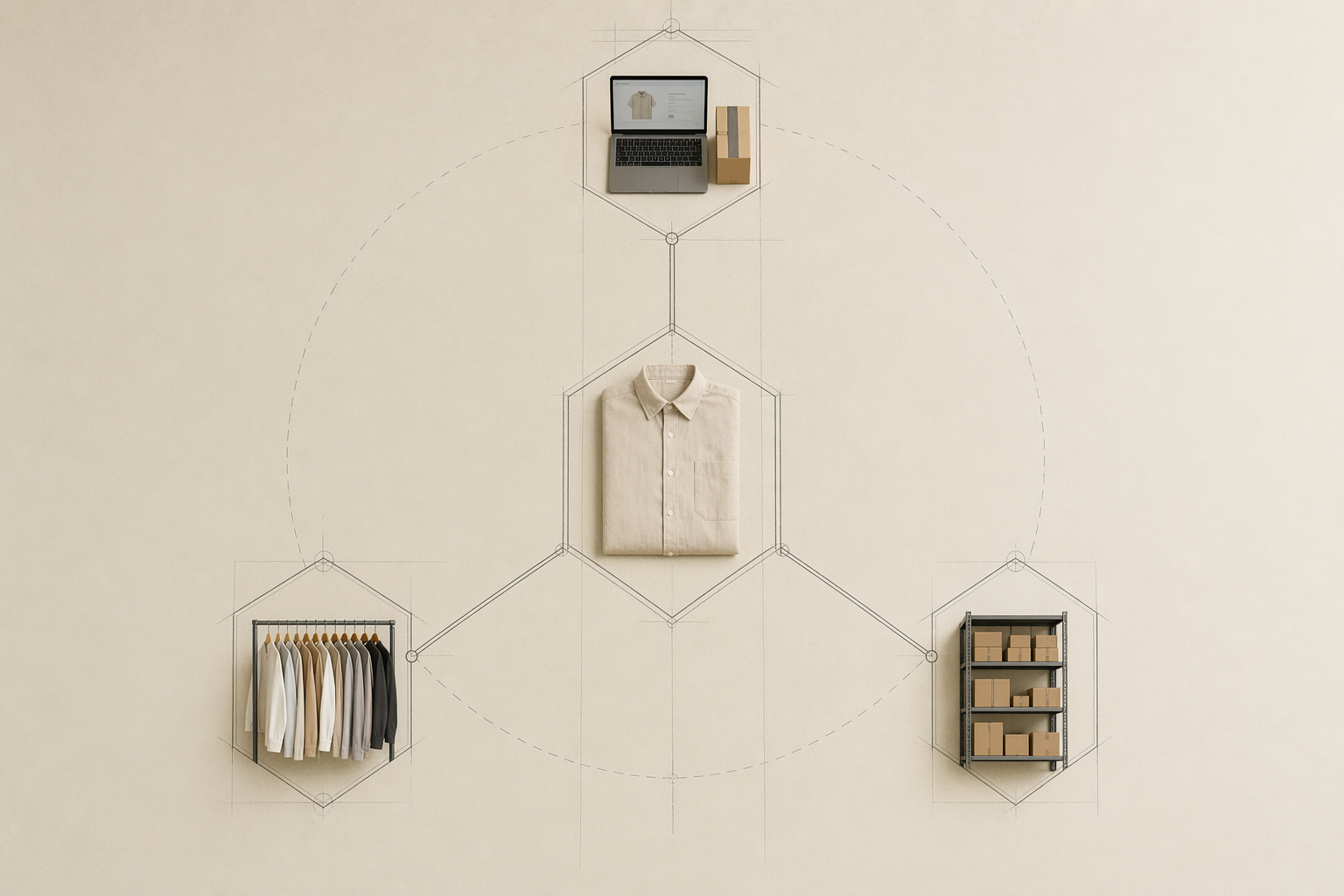
For an apparel brand running both wholesale and DTC, fashion ecommerce software is only half the picture. The storefront sells; the ERP behind it has to hold product data, inventory, and orders so the two never disagree. This guide covers what to want from an ERP and ecommerce integration, and where the connection breaks when it is missing.
What is Fashion ecommerce Software?
Fashion e-commerce software refers to specialized platforms designed to help fashion brands manage online stores. From showcasing products to handling orders and enhancing the customer experience, these solutions help brands run online sales and scale in an increasingly digital marketplace.
What Do You Want in the ecommerce Integration?
One of the major challenges of managing inventory for an e-commerce business is figuring out the right ERP (Enterprise Resource Planning) to use.
At a minimum you want the configuration to be simple and quick. You should be able to connect your products across the two platforms and keep the inventories in sync and accurate, available to sell inventory across both your ERP and your ecommerce platform. To reduce effort and to increase efficiency, you may want more functionality in the integration. Let us take a look at some features Uphance users find useful.

1. Pull Products From ecommerce Store Into Your ERP
This ability is useful only for new users of the ERP and does not have ongoing value. I find it very useful for new users as they are getting started with the ERP. They can get started importing products in a file but it generally takes a little effort organizing your data in the format required by the ERP system and actually importing the file. It may be easier for the new user to click a few buttons and let the system do the rest.
The other benefit of pulling from the ecommerce store is that you do not have to perform the next task of connecting existing products.
2. Connect Existing Products
This is a cumbersome process but may be unavoidable if you have been using both systems without integration. You do not want to start this way but many find themselves in this situation. If you are there, don't fret it. You only have to do it for one season. Your ERP and your ecommerce platform both have the same products but they do not have any knowledge of each other's products. In that case, you will have to manually and painstakingly connect each product.
You may like to organize products in your ERP with each product having multiple color variations. This is easier when working with sales, production, inventory, etc. Your retail customer may like to see each color as a separate product. Your integration should offer that flexibility.
3. Push Products from Your ERP to Your ecommerce Store
You have been designing, developing your products in your ERP and have been selling to your wholesale customer but now you are ready to get them on to ecommerce store to start selling your new season. Wouldn't it be great if you can click one button to send all products from your ERP to your ecommerce store? Of course, you want all of the detailed well-formatted HTML descriptions, multiple images for each variation, prices, product weight, customs and other shipping information to be pushed also without having to enter that information again on your ecommerce store.
Just as described in 2. above, you will want the ability to send your product as is or each color as a separate product.
4. Pull Customers and Orders
This is essential if you fulfill your retail orders from your ERP. Even in the case where you ship your ecommerce orders on your store platform, you may want the ability to bring customer records and all your retail orders into your ERP. Your ERP should have a clean way to separate your retail orders and customers from your wholesale business. You want your ERP to be able to provide a comprehensive overview of your business - both retail and wholesale.
5. Automatically sync inventory
Inventory management is one of the most critical components of apparel e-commerce. This is why it's important to go for an ERP that supports e-commerce integration and can sync inventory levels in real time.
When an ecommerce sale happens, the inventory is reduced on the ecommerce platform and the same reduction needs to reflect in your ERP. Returns and cancellations should similarly affect inventory on both platforms. If ecommerce ATS is reduced on the ERP due to any transaction, the new ATS inventory should immediately reflect in the ecommerce platform.
6. Advanced Features
Multiple stores: This may not be needed by small brands but I do see several brands having separate ecommerce stores for different regions, such as a US store and a Canada store. This may be due to the need to support different languages, currencies, etc.
Multiple warehouses:If you have multiple warehouses, you want your integration to have the ability to accurately affect inventories in the appropriate warehouse.
How Does Uphance Do It?
Uphance is not just an ERP; it is a complete management system for apparel brand operations. Product data, production, inventory, orders, and the ecommerce connection live in one system, so wholesale and DTC run from one operational record instead of two that drift apart. Book a tailored demo to see how it fits your channel mix.
Frequently asked questions
Where this fits in the Uphance platform
Venkat is the Founder and CEO of Uphance and the author of the 6 Breakpoints of Apparel Operations framework. He writes about operational clarity for apparel brands as complexity grows across channels, warehouses, partners, and teams. His work focuses on why disconnected operations, not growth itself, create the chaos most mid-market brands feel between $5M and $100M in revenue, and on the operating-model patterns that decide whether scaling a brand strengthens execution or fractures it. He argues that the status quo is the real competitor in apparel software, and that the right move is fewer systems with deeper connection, not more dashboards.
Ruchit writes about product strategy for apparel operations, covering how mid-market fashion brands use connected workflows to manage product development, inventory, orders, warehouse execution, and reporting. As Head of Product at Uphance, he shapes the roadmap that ties PLM, PIM, BOM management, allocation, fulfillment, and warehouse operations into one system. His articles dig into apparel-specific operational mechanics: tech packs, spec sheets, putaway, pick-pack, landed cost, and the data plumbing that makes inventory truth possible across multiple channels and locations. He focuses on the workflow-level questions that separate generic ERPs from systems built for how apparel brands actually run.